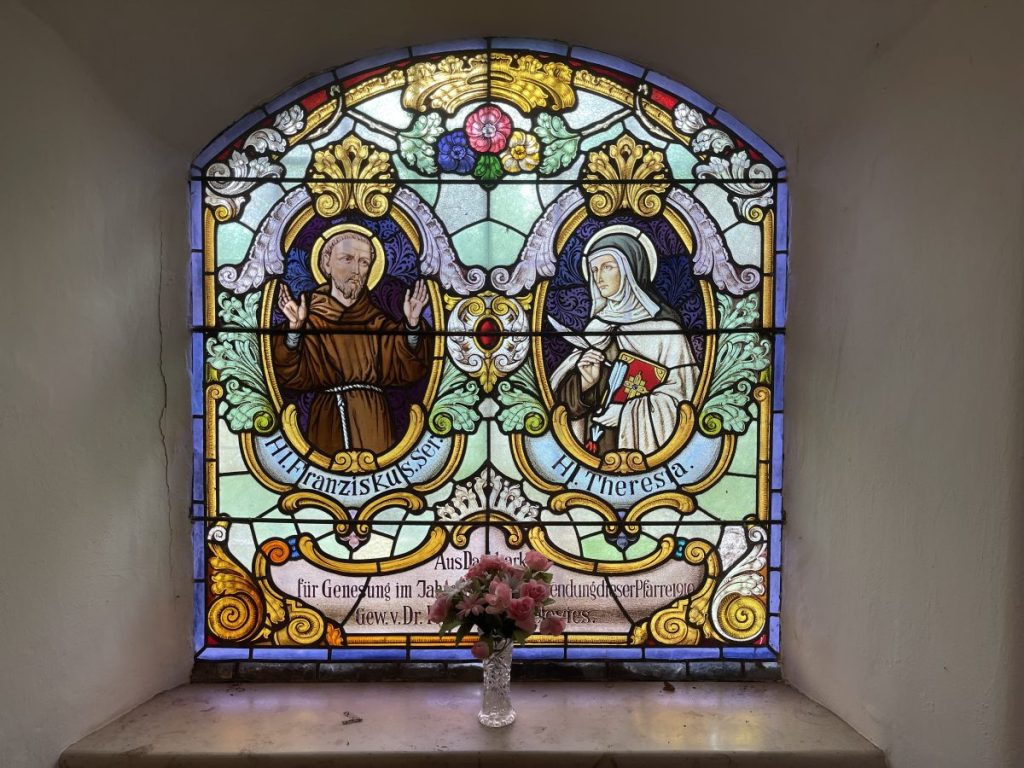
Der Jakobsweg Weinviertel.
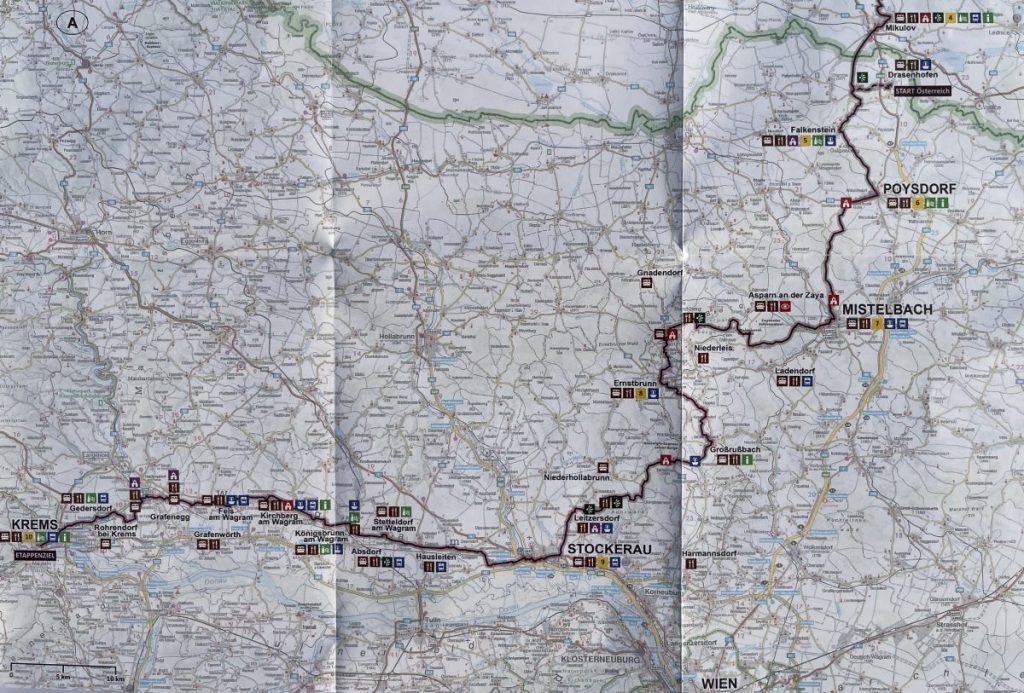
Der Jakobsweg Weinviertel translates in English to The Way of St. James Weinviertel. It is a Camino de Santiago pilgrimage walk that starts in Mikulov, in the Czech Republic, and finishes (after approximately 150 km) in Krems an der Donau, Austria.
I have experienced many mid-to-long-distance walks. If I were forced to choose one to eternally complete non-stop – reflecting Sisyphus – this would be my one Camino route choice. Besides, Albert Camus concluded in The Myth of Sisyphus, “The struggle itself towards the heights is enough to fill a man’s heart. One must imagine Sisyphus happy.”
What is and where is The Way of St. James Weinviertel?
Many people incorrectly suppose that Camino de Santiago routes are limited to Spain, but they most definitely are not.
Pilgrims can walk from Belgium, Poland, The Netherlands (and most other countries in Europe) along ancient pathways which all lead to Santiago de Compostela, Spain.
When I walked my 3,109 km from Prague to the Atlantic Ocean, I followed Camino routes through the Czech Republic, Germany, Switzerland, France, and Spain.
However, some routes have been created within the past few decades to capitalize on the growing demand for the pilgrimage experience – the Jakobsweg Weinviertel is one such route.
As already noted, this Camino starts in Mikulov (Nikolsburg in German) and winds its way through the off-the-tourist-radar Weinviertel wine region in the north-east of Austria. When you reach Krems an der Donau, you then have the option of joining the ancient Camino route that links Vienna with Santiago de Compostela.
The Weinviertel is a fascinating region in Austria – carved up after World War I, occupied by the Soviets after World War II, and rarely visited by tourists, despite its breathtaking scenery and close proximity to Vienna.
For Austrians wishing to begin their journey in Austria (avoiding the Czech Republic), the official starting point is Drasenhofen.
I know the region like the back of my hand because I spent four years living in Mikulov – a gorgeous town – and I am aware that some Austrians are still to this day wary of crossing the border into the Czech Republic.
When is the best time to go?
I recommend walking this route in the shoulder seasons of spring and autumn.
The region has a continental climate – extreme cold winters and extreme hot summers.
Spring and autumn present a Goldilocks period of weather when everything is usually pleasant and when you don’t need to carry so much equipment with you.
There are a lack of water fountains along the way, but there are also many towns and villages where you can stock up on supplies.
And, the locals – apart from one or two – are so approachable and friendly.
I’ve walked this Camino route in all four seasons.
In winter, I spent one night freezing on the ground in my sleeping bag because I was too cheap to book a hotel room. It was rough. It was very rough.
In summer, I found myself carrying 2x 1.5 liter bottles of water and even then running dry and asking the friendly locals to fill my bottles up for me.
The vegetation is fields, forest, wheat, and vineyards.
In times of conflict, wheat is the preferred crop.
This is a photo I took a few kilometers after starting out from Mikulov.
Mikulov Castle is prominently in the center, and the Chapel of St. Sebastian on Holy Hill is the small white structure on the right.

Is there pilgrim accommodation?
There is only one pilgrim albergue along the entirety of the route, in Kleinschweinbarth – approximately 5 km from Mikulov. The albergue is a donativo so I always leave a €10 donation. George, the priest, lives next door and he brews his own beer. He is an amazing Dutch priest and this well-equipped albergue puts many on the popular Camino routes to shame. You can either knock on George’s door, or call the phone number on the albergue window.
More recommended accommodation stops along the Weinviertel:
Mikulov
I highly recommend the recently-renovated Penzion Monner for its comfortable, artistically-designed rooms, for its location, and for the impressive breakfast and the equally impressive owners. Website: https://www.monnermikulov.cz/
Of course, if you are on a tight budget, you could always simply spend a few hours in Mikulov and then head to the next village: Kleinschweinbarth.
Still, it would be a shame to miss out on a full day and night in Mikulov.
For fine-dining options in Mikulov, I heartedly recommend Šílová Winery Mikulov. Website: https://vinosilova.cz/
For a great burger, Pedro’s Streetfood Bistro should be your number one priority. I would recommend avoiding the fries, though, as they are too stringy. The burgers, however, are by far the best in Mikulov. Website: https://pedrosfoodtruck.cz/
Poysdorf
Eisenhuthaus is a great value-for-money night’s stay, and the complimentary breakfast is enough to get you going for the walk to Mistelbach. Website: https://www.eisenhuthaus.com/
Poysdorf is a wine town and if you can, I highly recommend visiting Eric at his wine shop Wino – Brünner Str. 20c, 2170 Poysdorf.
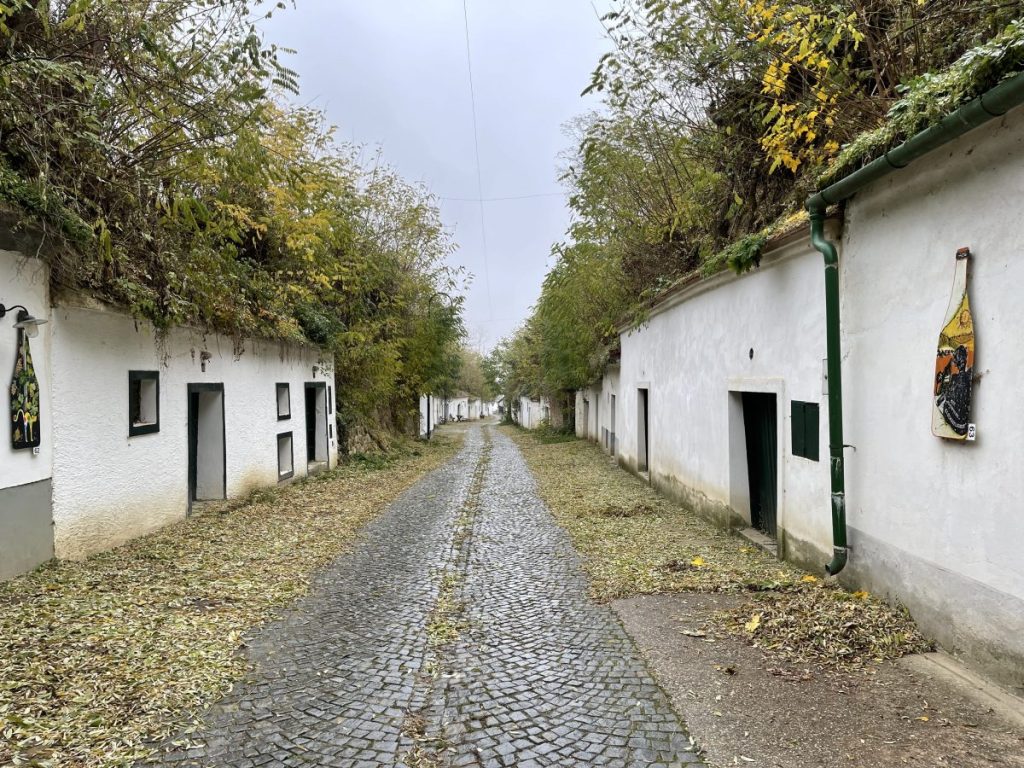
Or, you could simply take a leisurely walk up and down the Poysdorf Cellar Lanes.
Mistelbach
Mistelbach is a market town with fewer accommodation options than Poysdorf.
The clear winner here is Hotel Goldene Krone, a family-run hotel. The Chinese owner (who has lived in Austria for decades) plays for the Vienna Symphonic Orchestra. Website: https://katestravelexperience.eu/goldene-krone-mistelbach
For humungous portions of Schnitzel, head to Schnitzelhaus. Whenever I’m visiting from Spain, I always stop off here for a plate of Schnitzel, fries, and potato salad. The staff are very friendly and the quality of the food is excellent – Hafnerstraße 7, 2130 Mistelbach.
Großrußbach
The walk from Mistelbach to Großrußbach is one of the highlights of this Camino, and it is also the toughest day of walking with its gradual and then sudden increase in elevation.
I stayed at Gasthaus Schwarz – a fantastic accommodation option. The wife of the owner’s son speaks fluent English and we shared our Camino walk experiences. They also serve up excellent food, and every Thursday is Schnitzel Day! – Hauptstraße 2, 2114 Großrußbach. Just check ahead to see if they are open because they do change their opening hours depending upon the time of the year.
Food for the following day can be bought at the ADEG supermarket. A lovely Dutch woman works in the shop and she was so friendly and helpful to me when she found out that I was a pilgrim passing through. For such a small shop, they have a surprising choice of quality products – Hauptstraße 38, 2114 Großrußbach.
Stockerau
The walk from Großrußbach to Stockerau includes a climb up to (Allerheiligste Dreifaltigkeit) Katholische Kirche Karnabrunn, where there are toilet facilities, an electricity and a water source, and some (for me disturbing) World War II SS Soldier memorial photos. Still, it is a beautiful chapel with meticulous stained glass windows.
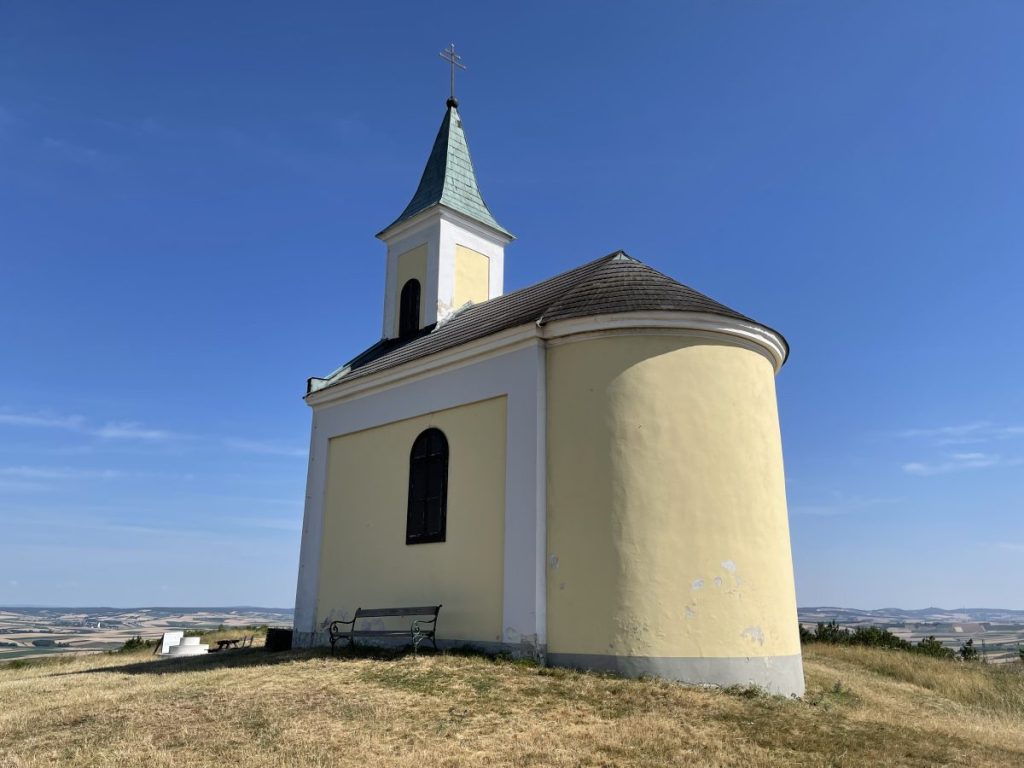
From the chapel (I really can’t understand its Kirche status) you pass through fields and forests (ticks are prevalent so protect yourselves) and then climb to a small plateau, until you reach the Michelberg chapel with its incredible views of Vienna from a perspective that almost no tourist visiting Vienna witnesses.
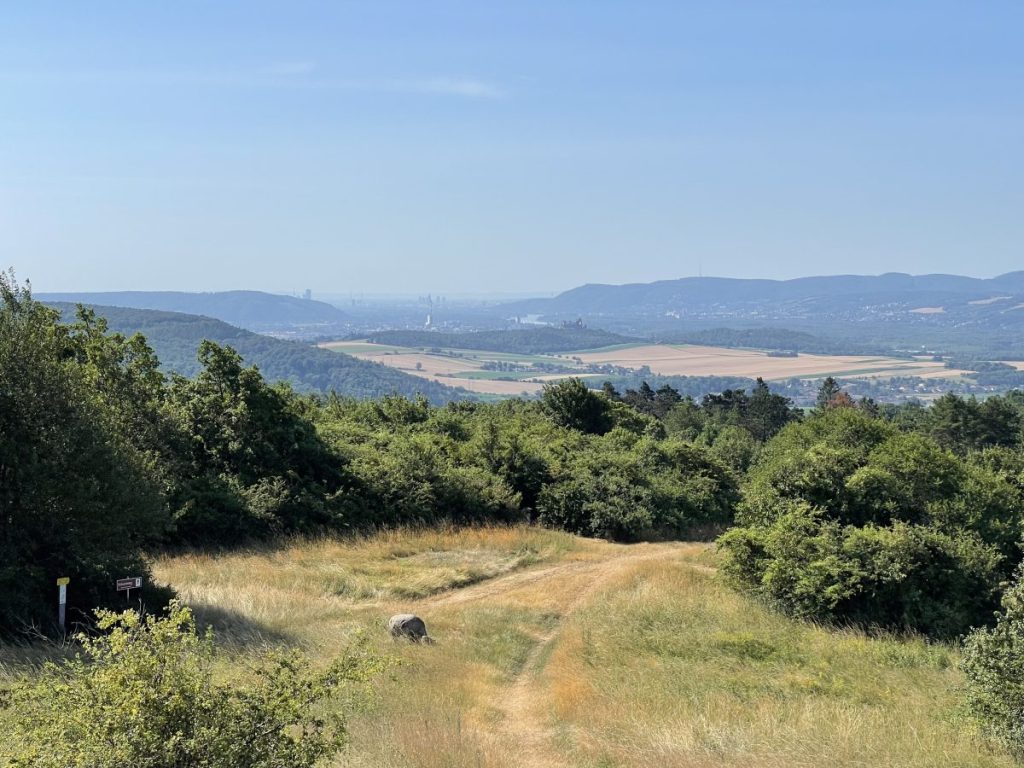
Stockerau is an OK town that obviously has seen its best days long gone, but it does have an Austro-Hungarian Empire charm in the same sense that many seaside towns do today in broken England (not that Austria is broken).
I chose to stay at the Familie Hopfeld – Hotel Dreikönigshof. It’s a family-run hotel and excellent. Website: https://www.hopfeld.at/
As the weather was so perfect on this trip, I decided to spend the rest of the walk sleeping outside, in my sleeping bag.
The next night, I slept in a field adjacent to the church in Hausleiten. I did ask if I could sleep on the church grounds, but the priest wasn’t around to either confirm yes or no.
Stupa of Peace
After a tough night’s sleep in a mosquito field in Hausleiten, I woke up early and decided to march my way to the end of this Camino.
The route now follows the contours of hills and Kirchberg am Wagram is a welcoming town, where you can stock up on supplies and where there seemed to be a number of accommodation options.
But, I was on a mission to walk as far as I could that day.
That is, until I thought I noticed a Stupa amongst the vineyards.
As it turned out, it was a Stupa amongst the vineyards.
Website: https://www.stupa.at/
I approached – it was getting dark – and I spoke with the wise-looking Korean monk about possibly spending the night on the grounds.
He made an exception to their rule of not allowing any overnight visitors, and I made my way anti-clockwise up to the top of the Stupa.
As I laid out my sleeping bag, I noticed the trail of airplane plumes overhead and the distant-sparkle of Christian monasteries that dot the other side of the Danube river.
I felt at peace. I meditated. I slept deeply.
It was an incredible night, sleeping below the illuminated light of the image of The Buddha.
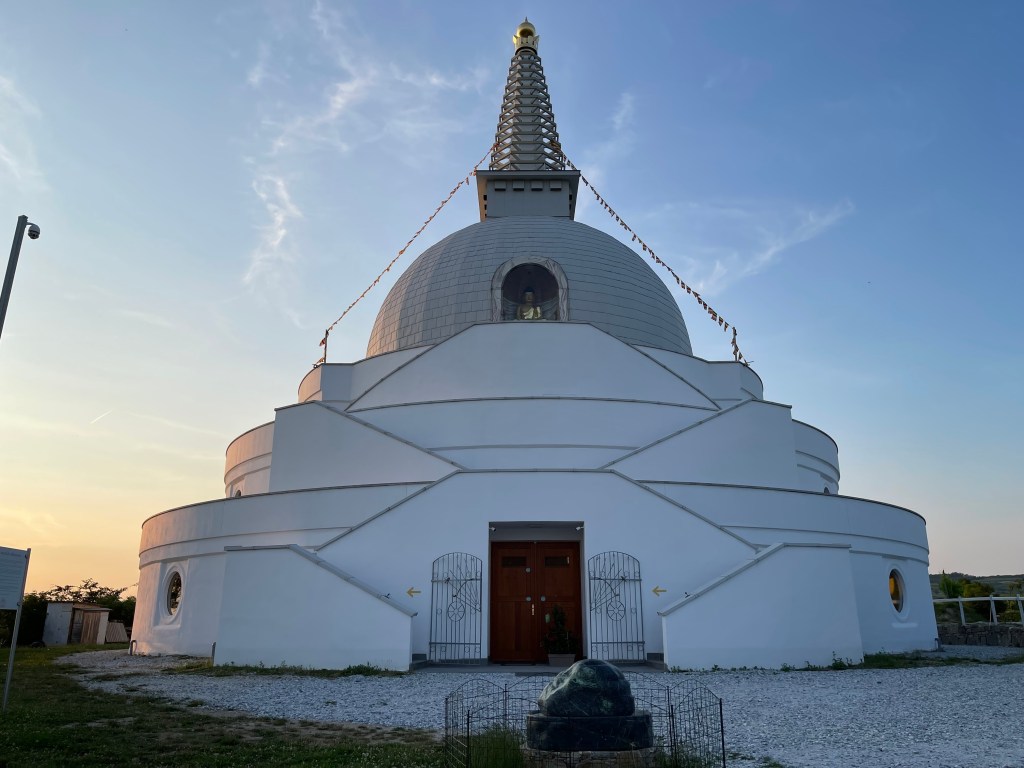
Krems an der Donau
After saying goodbye to the monk and thanking him for everything, I walked the last remaining kilometers to Krems an der Donau – a picturesque town, popular with tourists.
The final day was a topographically flat walk with no extraordinary events or places.
Krems an der Donau is beautiful, but I decided the hotels were cheaper and more varied in Vienna – I got the final pilgrim stamp in my pilgrim passport and caught the next train to Vienna, passing the Stupa along the way.
Wild Camping in the Austrian state of Lower Austria.
Despite having done it myself, wild camping in Lower Austria (the region in this article) is prohibited, with fines of up to €14,500 levied if caught.
But, there is a way around this by not breaking the law – just as I didn’t technically break the law the many times I have wild-camped in Lower Austria.
The law states that you cannot erect a tent, or spend the night in a van or car.
I do understand this law because they want visitors to use their accommodation services and because, frustratingly, not everyone adheres to the Leave No Trace principle.
The law states that you can wild camp if you find yourself in an UNPLANNED emergency situation – like the one time in Falkenstein when I sleeping-bag slept on the snowy steps of a chapel, on a holy hill, and was awoken by a friendly policeman who basically said I was free to keep shivering in the dark until the morning.
If the policeman had noticed I had a tent or even a sleeping mat (which I didn’t have) he would have been completely within his right to fine me – he very likely would have.
So my advice for all wild camping in Austria is to only do so with a sleeping bag.
If you are in the Alps, you will also need to completely hide yourself.
Oh, and sleeping in any national parks, protected areas, and in any forests is explicitly forbidden; sleeping bag or not.
Conclusion.
Der Jakobsweg Weinviertel makes the Via de la Plata seem busy – this is (for now) a solitary Camino walk that is sometimes also walked by the locals.
The locals whom I met were friendly, and many had walked their own camino in Spain – one woman had also walked across Austria.
As in Vienna, you might come across a couple of unpleasant people, but the vast majority of locals whom I have met over the years in this region are lovely.
The wine is excellent, the weather is appealing, the food is filling and tasty, and God lives in these lands – as well as a wise Buddhist monk.
Have a wonderful time walking Der Jakobsweg Weinviertel!
This post contains NO AFFILIATE LINKS and as the author of this post, I earn nothing for recommendations I suggest in my posts on this website. Affiliate linking, when conducted correctly, can be a benefit for the reader and the author, but I choose not to make an additional income from places and products that I personally recommend from my own personal experience. I am not a fan of affiliate linking as, is often the case, an author promotes a business primarily for the financial incentive. Neville David Thomas.
Read more blog posts: https://nevilledavidthomas.com/blog/
Have you walked Der Jakobsweg Weinviertel? Do you agree or disagree with any of the content that I have mentioned in this post? Do you have any additional information that you would like to share? Please leave a comment below!




 Neville David Thomas
Write a Comment!