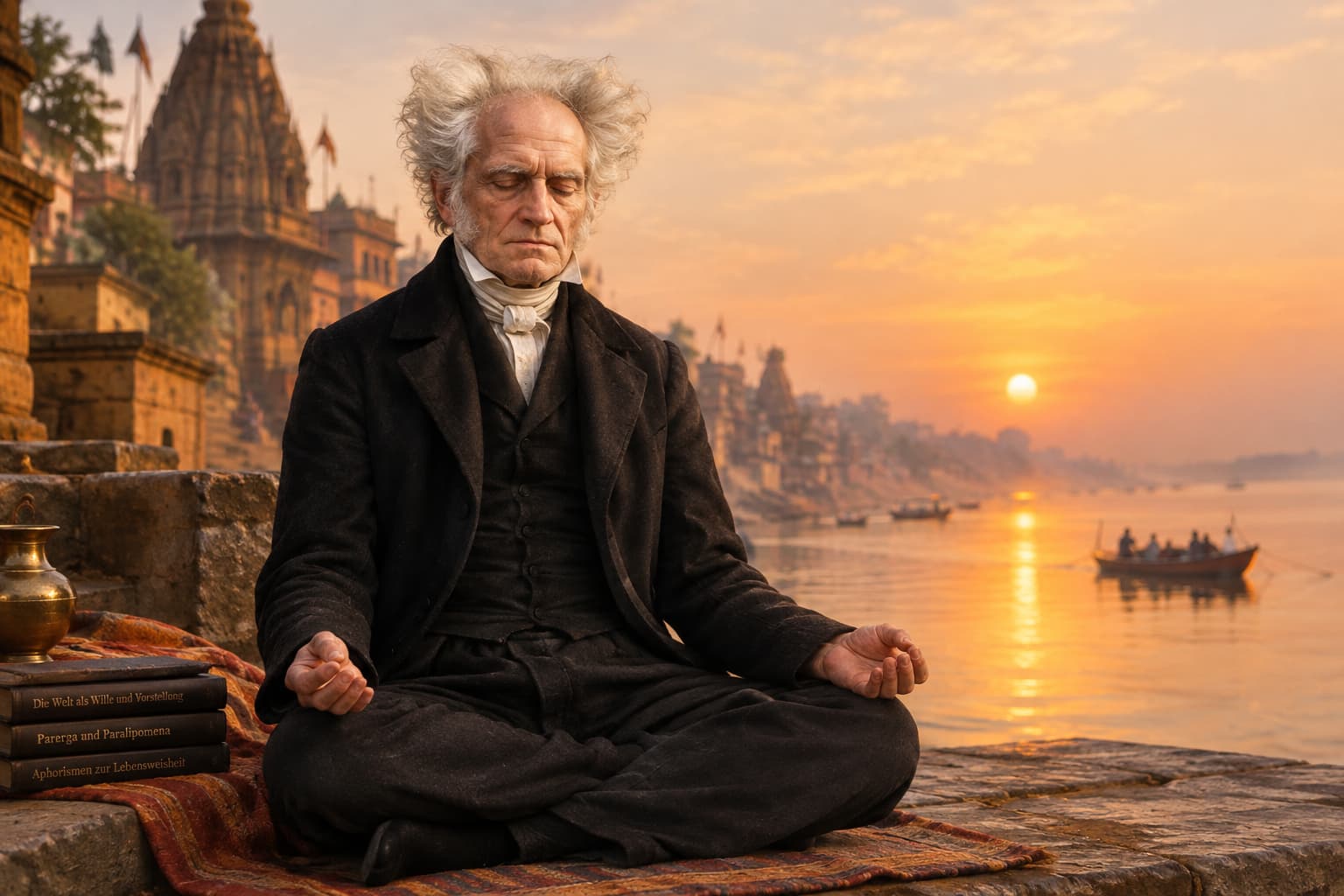
Arthur Schopenhauer was not, by most accounts, a particularly cheerful man.
Born in Danzig in 1788 and passing in Frankfurt in 1860, the German philosopher spent much of his intellectual life arguing that human beings like to imagine they are rational creatures when, in fact, we are rather more like badly supervised animals with postgraduate degrees.
His masterpiece, The World as Will and Representation (Die Welt als Wille und Vorstellung), first published in 1818 and substantially expanded in 1844, contains the central idea that made Schopenhauer famous: beneath our rational explanations and respectable narratives lies something much more primitive – the will to live.
We think we make choices. Schopenhauer thought that, very often, the choice has already been made somewhere deeper inside us and our intellect simply arrives afterward to write the press release.
This sounds rather bleak. It is also remarkably useful.
The will to live: your brain may not be running the show
Schopenhauer’s “Will” is not simply wanting to have another Zyn or deciding to buy a new pair of trail-running shoes. It is much bigger than that. He regarded the Will as the fundamental, irrational striving underlying life itself: the relentless impulse to continue existing, reproducing, wanting, pursuing and striving.
The problem is that the Will does not have a particularly sophisticated long-term plan.
It wants.
Then it gets.
Then it wants something else.
And because the object of desire can never permanently satisfy the mechanism that produces desire, human beings spend much of their lives running on a treadmill while congratulating themselves for the scenery.
In The World as Will and Representation, Schopenhauer argues that individual actions have motives, but the Will itself has no ultimate reason. We can explain why we did something, but that does not necessarily explain why we are creatures who keep wanting things in the first place. The Will is not a carefully considered decision. It is a force of striving.
This becomes particularly entertaining (and slightly horrifying) when Schopenhauer applies the theory to romantic love.
We like to believe that falling in love is one of the great triumphs of individual consciousness. We meet somebody. We recognize their wonderful personality. We appreciate their intelligence. We discover their soul.
Schopenhauer’s response, essentially, is: how adorable.
In the chapter The Metaphysics of Sexual Love, included in the second volume of The World as Will and Representation, he argues that sexual attraction is largely the Will of the species operating through individuals. We experience it as intensely personal – I love this particular person – but Schopenhauer thinks the deeper mechanism is the biological imperative to produce the next generation.
This explains, in his view, one of the great mysteries of human existence: why otherwise sensible people sometimes become spectacularly irrational when they fall in love.
You can have a perfectly intelligent person who spends years developing good judgment and sound financial habits, only to meet somebody attractive and immediately decide that moving across the country, abandoning their friends, spending their savings and marrying somebody they barely know is obviously an excellent idea.
Schopenhauer would not necessarily be surprised.
He thought passionate love could become so overwhelming that it might lead people to sacrifice wealth, reputation, happiness and even life itself. In extreme cases, he argued, frustrated passion could result in madness or suicide.
His explanation is deliciously brutal: nature has an interest in reproduction, but the individual does not necessarily understand that interest. So nature disguises the species’ objective as the individual’s happiness.
In other words, evolution does not send you a memo saying:
Congratulations. Your hormones have identified a potentially suitable reproductive partner.
It sends you butterflies.
You then write poetry about them.
Schopenhauer’s particularly provocative claim is that love marriages can therefore be disastrous for the individuals involved while being perfectly successful from the perspective of the species. The lovers believe they are pursuing their own happiness; Schopenhauer thinks they may actually be serving a biological program whose interests are considerably less concerned with their happiness than with the children they might produce.
This is, obviously, an extremely nineteenth-century theory of sex, and parts of it are deeply problematic by modern standards. Schopenhauer also makes sweeping assumptions about men, women, attraction and reproduction that should not be mistaken for scientific fact.
But the broader psychological observation remains interesting:
we are very good at constructing rational explanations for desires that may have originated somewhere considerably less rational.
That idea has aged rather better than some of his biology.
Then there is society: congratulations, you’ve become somebody else
Schopenhauer was equally suspicious of what happens when human beings leave the privacy of their own minds and enter society.
Here he becomes almost comically modern.
In Parerga and Paralipomena, particularly the essay collection usually translated as Aphorisms on the Wisdom of Life, he argues that social life requires an extraordinary amount of self-suppression. Society demands politeness, conformity and restraint. We modify ourselves because other people are watching.
And Schopenhauer thought we modify ourselves A LOT.
In one famous passage he argues that, in order to fit comfortably into ordinary society, we may have to sacrifice roughly three-fourths of ourselves – becoming less intellectually interesting, less individual and less naturally ourselves so that other people can tolerate our company.
This is the part of Schopenhauer that feels strangely contemporary.
Think about the difference between the person who is sitting alone at home and the person who walks into a room full of colleagues.
At home, you may have strong opinions about politics, terrible taste in music, an obsession with some obscure historical event and absolutely no desire to discuss the weather.
Then you go to work.
Suddenly you are interested in the weather.
You laugh at jokes you don’t find funny.
You pretend not to notice the person behaving badly.
You say “We should definitely do this sometime” when you know perfectly well that you will do everything in your power to ensure that this never happens.
We call this manners.
Schopenhauer called much of it self-denial.
And perhaps he had a point.
The remarkable thing about social behavior is not merely that people behave differently around others. It is that we often become different versions of ourselves depending on who is watching.
The office version.
The family version.
The romantic version.
The version who meets old school friends.
The version who talks to a waiter.
The version who posts on Instagram.
The version who comments anonymously on the internet at 2:17 in the morning.
The version who walks the Camino de Santiago?
Schopenhauer understood that society works partly because human beings are willing to edit themselves.
There is an obvious upside to this. If everyone behaved exactly as they felt at every moment, civilization would probably last about eleven minutes. Politeness is useful. Restraint is useful. We should not tell someone exactly what we think of their new partner, or that someone’s child behaves like a monster.
But Schopenhauer’s deeper point is that social life has a psychological cost.
To belong, we suppress.
To be liked, we adjust.
To avoid conflict, we compromise.
To be considered normal, we conceal the parts of ourselves that might make other people uncomfortable.
And eventually it becomes difficult to know where the social mask ends and the person underneath begins.
Two-thirds will, one-third intellect
There is another numerical observation from Schopenhauer that fits surprisingly well with this argument.
In the second volume of The World as Will and Representation, when discussing genius and intellect, Schopenhauer contrasts the ordinary person with the genius. His deliberately rough formulation is that the normal person consists of approximately two-thirds will and one-third intellect, while the genius reverses the proportions: two-thirds intellect and one-third will.
This should not be read as a neurological measurement. Schopenhauer was not conducting brain scans.
His point is philosophical.
For most people, intellect is ultimately employed in the service of desire. We think in order to get what we want. We calculate, plan and reason – but the Will is sitting in the driver’s seat.
The exceptional person, Schopenhauer believed, can sometimes reverse the arrangement. Intellect becomes capable of looking at the world without immediately asking:
What can I get out of this?
That, for him, was one of the characteristics of genius.
It is also connected to his theory of art. When we become absorbed in music, painting, literature or nature, we can temporarily stop looking at everything in terms of our personal desires. For a moment, we are not calculating what something is worth to us. We are simply looking.
Schopenhauer thought this was one of the few genuine holidays/vacations available from the tyranny of the Will.
And perhaps that explains why art can sometimes feel like relief.
You stop wanting.
You simply see.
Schopenhauer and Buddhism: the unusually cheerful part
For all his reputation as philosophy’s great pessimist, Schopenhauer was also fascinated by ideas coming from India, particularly the Upanishads and Buddhism.
This was unusual in nineteenth-century European philosophy. His engagement with Indian thought was partly mediated through translations, especially the Latin Oupnek’hat, and his understanding of Buddhism was inevitably shaped by the limited and sometimes inaccurate sources available to him. Nevertheless, Indian philosophy became an important part of his intellectual world.
Schopenhauer saw striking parallels between his own philosophy and Buddhist ideas.
The resemblance is obvious once you place the two side by side.
Buddhist thought identifies craving and attachment as fundamental sources of suffering. Schopenhauer identifies the endless striving of the Will as the fundamental source of suffering.
Buddhism points toward the cessation of craving.
Schopenhauer points toward the denial of the Will.
He even ends the first volume of The World as Will and Representation by invoking Buddhist imagery, comparing the ultimate state of liberation from willing to Prajñāpāramitā, while describing the disappearance of the ordinary world of desire in strikingly mystical terms.
There is an important qualification here: Schopenhauer did not simply reproduce Buddhism in German philosophical clothing. His knowledge of Buddhism was incomplete, and scholars continue to debate exactly how Buddhist and Hindu ideas influenced his system. His interpretation was his own, filtered through Kant, European metaphysics and the sources available to him.
Still, the intellectual encounter was remarkable.
A German philosopher who believed that existence was fundamentally characterized by dissatisfaction looked towards Buddhist thought and found something that seemed to say: yes, precisely – the problem is wanting.
That must have been quite a moment.
So was Schopenhauer right?
Obviously, not about everything.
He was frequently misogynistic. Some of his ideas about sex and reproduction are dated, speculative or simply wrong. His pessimism can also become so extreme that you occasionally want to shake him and tell him to go for a walk – a Camino, perhaps?
But dismissing Schopenhauer as merely the world’s most miserable German philosopher would be a mistake.
His great insight was not that human beings are stupid.
It was that human intelligence is not necessarily in charge.
We want first and rationalize afterwards.
We fall in love and then construct elaborate explanations for why this particular person is obviously perfect for us.
We join groups and quietly modify our personalities to fit them.
We call our desires “decisions.”
We call our instincts “values.”
We call conformity “being normal.”
And we sometimes mistake the story we tell ourselves about our behavior for the actual reason we behaved that way.
That is what makes Schopenhauer unexpectedly relevant today.
We live in an age that is obsessed with personal choice. We are told to discover ourselves, express ourselves, optimize ourselves and – preferably before breakfast – become the best possible version of ourselves.
Schopenhauer would probably have found the whole thing exhausting.
He might have suggested that before trying to become a better version of yourself, you should first ask a rather more uncomfortable question:
Who, exactly, is doing the wanting?
Because perhaps the strangest thing about being human is not that we have desires.
It is that we can spend an entire lifetime obeying them while convincing ourselves that we are free.
Food for thought?
Something to think about – if the Will lets you.
This post contains NO AFFILIATE LINKS and as the author of this post, I earn nothing for recommendations I suggest in my posts on this website. Affiliate linking, when conducted correctly, can be a benefit for the reader and the author, but I choose not to make an additional income from places and products that I personally recommend from my own personal experience. I am not a fan of affiliate linking as, is often the case, an author promotes a business primarily for the financial incentive. Neville David Thomas.
Read more blog posts: https://nevilledavidthomas.com/blog/
Do you agree or disagree with any of the content that I have mentioned in this post? Do you have any additional information that you would like to share? Please leave a comment below!






Leave a Reply