Somewhere in the world, a person is lying on the floor of their life being told that everything happens for a reason.
The person saying this is holding an oat-milk flat white, has never once been asked to produce the reason, and will probably be on a yoga retreat when it fails to arrive.
We are, it seems, a civilization that has outsourced its resilience to people who describe a mild inconvenience as “a journey.”
I would like to offer something sturdier.
It is older, it is Japanese, and it makes no promises.
Nana korobi ya oki.
Fall down seven times, stand up eight.
七転び八起き.
The proverb has the great virtue of not pretending that life will be kind. It doesn’t tell you that everything happens for a reason. It doesn’t promise that things will work out. It doesn’t even say that you will learn something useful from the experience.
It simply assumes that you will fall down.
Seven times, in fact.
Seven.
It budgets for failure. It budgets for exhaustion, humiliation, disappointment, bad decisions, bad luck, and those days when getting off the floor seems like an unreasonable demand.
It merely insists on the eighth thing.
Stand up.
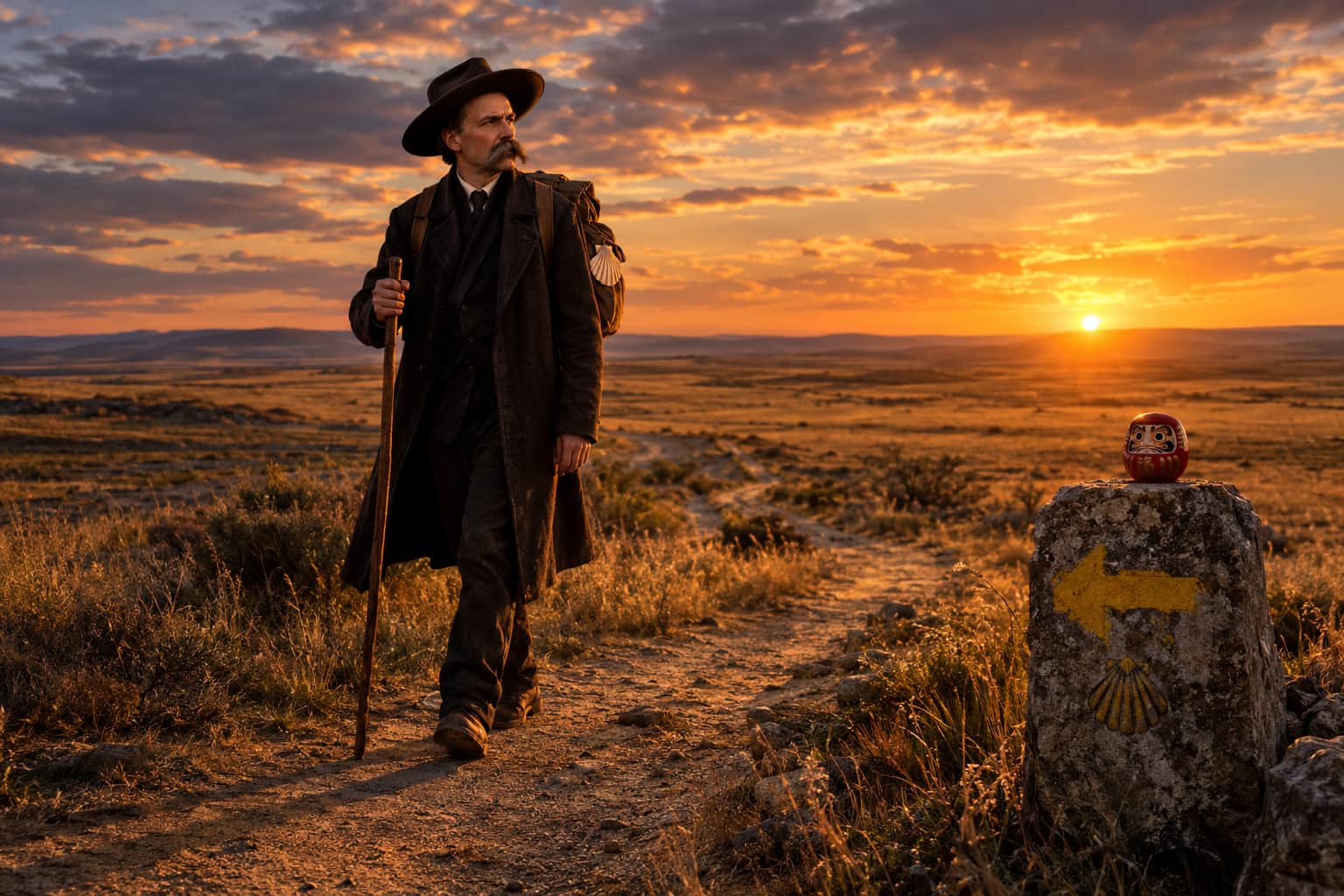
You will recognize the spirit in the Daruma doll, the round, weighted Japanese figure that rights itself however many times you knock it over. It is, in effect, a small red metaphor for the human condition, usually sold with a face painted on it that suggests it has seen things.
Which brings us to Friedrich Nietzsche.
The philosopher and the people who borrowed him badly
Nietzsche has had a remarkably bad afterlife.
He has been misread by teenage nihilists, self-help entrepreneurs, internet philosophers, and men in podcast studios who have read one paragraph and discovered that they are, apparently, beyond good and evil.
The Nazis also appropriated him, selectively turning parts of his philosophy into something much more compatible with their own ideology than Nietzsche himself would have recognized.
His sister, Elisabeth Förster-Nietzsche, played an important role in the later distortion of his reputation. After Nietzsche’s collapse, she took control of much of his literary estate and helped shape the presentation of his unpublished material. Decades later, Nazi interpreters mined his writings selectively, emphasizing passages that could be made to serve their purposes while ignoring Nietzsche’s repeated attacks on German nationalism and antisemitism.
And then there is The Will to Power, supposedly the great Nietzschean system.
Except Nietzsche never finished it.
What we have is a posthumous compilation of notes assembled and edited after his death. Treating it as though Nietzsche had completed a book called The Will to Power and left behind a tidy philosophical system is, at best, misleading.
It was a remarkable piece of intellectual repackaging.
It is as if someone selectively quoted your diary at your funeral, and the quotes had been chosen by the worst person in your family.
The important thing, though, is that Nietzsche is worth taking back.
Because the Nietzsche I find useful here is not the caricature: not the conqueror, not the storm trooper, not the internet alpha male, and not the guy who has just discovered cold plunges.
He is the philosopher who keeps asking what we can do with the fact that life is difficult.
Not how we can escape it.
Not how we can explain it away.
What can we do with it?
The bits worth actually reading
Here is the Nietzsche I would recommend, with the references included so you can check that I am not doing an Elisabeth.
“What does not kill me makes me stronger.”
Twilight of the Idols, “Maxims and Arrows,” §8.
It has been printed on a million gym towels, and it has acquired a much cheerier reputation than Nietzsche probably intended.
He wrote it while living with chronic illness, severe headaches, failing eyesight, and increasing physical difficulties that had already forced him to give up his professorship at Basel.
But there is an important distinction here.
Nietzsche was not simply saying that suffering automatically makes you stronger. Life doesn’t work that neatly. Some things hurt us. Some things damage us. Some things simply hurt.
The interesting question is what we do with what happens to us.
That brings us to amor fati– the love of fate.
In Ecce Homo, Nietzsche calls amor fati his formula for greatness: wanting nothing to be different, “not forward, not backward, not in all eternity.”
That is a considerably more radical idea than simply putting up with whatever happens.
It is not:
This is terrible, but I suppose I have to endure it.
It is closer to:
This is my life. What can I make of it?
That is a difficult question to ask when you have just fallen down for the sixth time.
Then there is the eternal recurrence.
In The Gay Science, §341, Nietzsche imagines a demon appearing in your loneliest loneliness and telling you that you will have to live your entire life again, exactly as it is, innumerable times.
Every joy.
Every humiliation.
Every mistake.
Every ordinary Tuesday.
Every moment you wish had gone differently.
Would you curse the demon?
Or could you eventually say yes?
Whatever one makes of the metaphysical question, the psychological challenge is brutal: can you affirm your life without first demanding that it be rewritten?
And then there are the three metamorphoses in Thus Spoke Zarathustra.
The spirit begins as a camel, kneeling to be loaded with everything it is expected to carry.
Then it becomes a lion, saying “I will” and fighting the great dragon of “thou shalt.”
And finally it becomes a child: innocence, beginning again, a sacred yes.
Keep the camel in mind.
We’ll be back to it.
And it has a backpack.
Nietzsche also wrote that “only thoughts reached by walking have value.”
Which brings us, conveniently, to the Camino.
Enter the pilgrims
The Camino de Santiago is not one road but a network of pilgrimage routes leading to Santiago de Compostela. The Camino Francés, beginning traditionally at Saint-Jean-Pied-de-Port, runs for roughly 780 kilometers across northern Spain before reaching Santiago.
People walk it for religious reasons, spiritual reasons, historical reasons, personal reasons, no particular reason at all, or because they have reached a point in their lives where sitting around thinking about things has stopped working.
You walk instead.
You walk over the Pyrenees.
You walk through rain.
You walk through heat.
You walk past vineyards and churches and fields of sunflowers and enormous stretches of nothing.
You walk with blisters, sore feet, questionable laundry decisions, and the increasingly urgent realization that the person who told you your boots were “already broken in” may have been lying.
Nietzsche, who regarded walking as fundamental to thinking, would at least have had a philosophical reason to tolerate the blisters.
He might have struggled with the albergues.
I should declare an interest here.
I snore.
Had Nietzsche shared a dormitory with me, “God is dead” would have been the mildest thing he wrote that week.
But there is something about long-distance walking that Nietzsche understood.
Walking strips things down.
You carry what you need.
You eat when you are hungry.
You stop when you have to.
You discover very quickly which possessions are essential and which were purchased by someone who had never walked 30 kilometers with a backpack.
And sooner or later, the camel appears.
Every pilgrim begins, perhaps, as one.
Kneeling to be loaded:
The backpack.
The expectations.
The blister kit.
The guidebook.
The hopes.
The doubts.
The Instagram caption you’ve already drafted.
Then the Pyrenees happen.
Or the Meseta, that long, flat, relentless plateau where the horizon seems to be actively mocking you.
Or it is simply a Tuesday in week two, and your knee has developed opinions.
This is the wall.
And sooner or later, almost everyone who walks a long distance meets some version of it.
Not just the unprepared.
Not just the unfit.
Not just the people who bought their boots the day before.
The experienced meet it.
The stubborn meet it.
The superbly equipped meet it.
It simply turns up, usually uninvited and usually at the worst possible moment, like the one hill you were certain the map had forgotten to mention.
And when it does, you discover something none of us particularly likes to discover.
Nobody is coming to walk the road for you.
The myth of the cavalry
There is a fantasy buried deep in us that somewhere, somehow, the cavalry will arrive.
Someone will recognize how difficult this has become.
Someone will understand.
Someone will fix it.
Someone will say:
You’ve suffered enough.
I’ll take it from here.
On the Camino, this fantasy becomes almost comically literal.
Nobody is going to turn up at kilometer 412 wearing a sash and carrying a sandwich and announce that you have been officially excused from the remaining distance.
There are, of course, hospitaleras and hospitaleros.
There are taxis.
There are bag-transport services.
There are pharmacies, cafes, fellow pilgrims, and strangers who will hand you water.
The Camino is, in many ways, extraordinarily generous.
But nobody can walk your kilometers for you.
The next step remains yours.
And strangely, that is good news.
Because there is another idea hidden inside the absence of rescue.
You are not powerless simply because nobody else can do the walking.
The lion doesn’t wait for permission.
But there is an important qualification here, one I learned the hard way:
Nobody is coming to walk for you does not mean nobody is coming.
People can still stand at the edge.
They can shout.
They can offer water.
They can listen.
They can tell you that what feels like the end may simply be Tuesday.
I know this because it happened to me.
My wall
I walked from Prague’s Old Town Square to Finisterre on the Spanish coast, all in one journey and entirely on foot.
3,109 kilometers.
I would love to tell you it was a serene procession of one heroic step after another.
It was not.
My wall arrived in a small village in France.
I cannot, for the life of me, remember its name, which tells you something about how much attention I was paying to anything except my own misery.
What I do remember, with total clarity, is a patch of grass opposite a church.
And a grown man splayed across it like a starfish dropped from a great height.
My body, interestingly, was not the problem.
My mind was.
It was doing the pleading, and it was pleading with remarkable eloquence.
Stop.
Just stop.
Sit here.
Go home.
You have done enough.
You cannot do this.
I felt pathetic.
I am quite sure I looked pathetic.
And I had a meltdown.
I’ll admit it because there is no point writing about a wall if you are going to pretend you simply strode through it while the violins played.
At the time, I was writing a blog about the journey. It no longer exists online.
I was, I think, terribly honest in it.
I didn’t polish the low points into anecdotes.
I wrote what they actually felt like.
The comments that came back were few, but they were kind.
And almost every one said essentially the same thing:
Please don’t give up.
This is a moment.
It will pass.
I want to be precise about what that taught me, because it complicates the whole “nobody is coming” idea.
Nobody on the internet could lift my feet off that grass.
Nobody could walk the next kilometer for me.
But those people were not trying to.
They were standing at the verge.
They were shouting.
And it turns out that a voice from the verge can sometimes be enough to get a person off the grass.
That distinction matters.
Being responsible for your own life does not mean being responsible for everything alone.
Being your own hero, if we insist on using that word, does not mean being your own only audience.
The walking is yours.
The encouragement is allowed.
The wall is not a verdict
The most important thing I learned on that patch of grass was not that I was tougher than I thought.
It was that I was less reliable at predicting the future than I thought.
At the time, the feeling was enormous.
It felt permanent.
It felt like a verdict.
It felt like a statement about who I was and what I could do.
But it wasn’t.
It was a weather system.
It arrived with great force.
It stayed for a while.
And then it moved on without asking my permission.
A few days later, I could barely remember exactly what it had been so certain about.
That, I think, is one of the most useful things we can learn from difficult periods of life.
A feeling can be completely real without being permanently true.
Despair is real.
Exhaustion is real.
Fear is real.
Humiliation is real.
But none of those things has the authority to tell you what happens next.
The wall is not a verdict.
It is a wall.
Sometimes you climb it.
Sometimes you go around it.
Sometimes you sit beside it for a day.
Sometimes you turn back.
There is no moral prize for destroying yourself against it.
Resting is not quitting.
Changing direction is not necessarily failure.
And continuing is not necessarily heroic.
Sometimes it is simply the next thing.
For anyone on the floor
If you are reading this from the floor of some difficult stretch of your life, I am not going to tell you that everything happens for a reason.
That is the everything-happens-for-a-reason school, and I have sworn off it.
I don’t know whether everything happens for a reason.
Neither do you.
And pretending otherwise doesn’t make the floor any softer.
What I can tell you is what the proverb, Nietzsche, the Camino, and a few sunburned strangers seem to have taught me:
- The falls are not a verdict. They are in the budget. Seven of them.
- Stopping for the day is allowed. Resting isn’t quitting.
- You don’t have to love the wall. You only have to remember that the wall is not the whole landscape.
- Say what is true. Out loud or in writing. Honesty is how the people at the verge find you.
- Nobody can take the next step for you. But that doesn’t mean you have to take it unheard.
And perhaps that last point is the one I got wrong when I was lying on the grass.
I thought strength meant not needing anyone.
It doesn’t.
Strength can mean accepting the water.
It can mean listening when someone says, “Keep going.”
It can mean allowing another person to remind you of something you temporarily cannot believe yourself:
This is a moment.
It will pass.
Rilke put the whole thing better than I can in “Go to the Limits of Your Longing,” from The Book of Hours:
“Let everything happen to you: beauty and terror.
Just keep going.
No feeling is final.”
No feeling is final.
Not the despair on the grass.
Not the shame of the tears.
Not the conviction that this is where it ends.
The feeling may be enormous.
It may even be telling the truth about this moment.
But it does not get to write the next chapter.
Fall down seven times.
Stand up eight.
And if you can’t manage eight today, lie there a while.
Have some water.
Look at the sky.
Let the people at the verge shout a little louder.
And let the Daruma in you do what it does.
Get back up.
This post contains NO AFFILIATE LINKS and as the author of this post, I earn nothing for recommendations I suggest in my posts on this website. Affiliate linking, when conducted correctly, can be a benefit for the reader and the author, but I choose not to make an additional income from places and products that I personally recommend from my own personal experience. I am not a fan of affiliate linking as, is often the case, an author promotes a business primarily for the financial incentive. Neville David Thomas.
Read more blog posts: https://nevilledavidthomas.com/blog/
Do you agree or disagree with any of the content that I have mentioned in this post? Do you have any additional information that you would like to share? Please leave a comment below!



Leave a Reply