
There is something rather amusing about the fact that one of the most important mathematical breakthroughs of 2026 concerns something as ordinary as water.
We see water every day. We drink it, wash in it, swim in it and occasionally fall into it after having had a little too much to drink. We rarely give much thought to the extraordinary complexity of its movement.
Mathematicians, however, have been rather more interested.
The Navier–Stokes equations, which describe how fluids such as water and air move, have been troubling some of the world’s finest mathematical minds for generations. One of the questions associated with these equations remained unanswered for approximately 90 years and became one of the seven famous Millennium Prize Problems.
Then, in September 2026, OpenAI announced that an artificial intelligence system had produced a proposed solution.
This was no ordinary mathematical exercise. The system coordinated approximately 10,000 AI agents, which worked on the problem for around 88 hours. The resulting proof was subsequently formalized using Lean, a system that allows mathematical proofs to be checked with considerable precision.
OpenAI’s announcement was extraordinary. The Clay Mathematics Institute, which established the Millennium Prize Problems, subsequently acknowledged that the problem appeared to have been settled, although its formal evaluation process remains to be completed.
But there is something about this particular mathematical problem that I find especially interesting.
It provides a rather unexpected starting point for thinking about Buddhism, impermanence and the nature of existence.
And, as it happens, a certain Greek philosopher who lived approximately 2,500 years ago had already been thinking along similar lines.
So what exactly is the Navier–Stokes problem?
Before we get too philosophical, a little mathematics is probably necessary.
Don’t worry. I promise not to turn this into a university lecture.
The Navier–Stokes equations describe the movement of fluids. They take into account things such as velocity, pressure, viscosity and the forces acting upon a fluid.
They are important in everything from aircraft design and weather forecasting to the study of blood circulation.
The difficulty is that although we can write down equations describing fluid movement, understanding exactly how those equations behave under all possible circumstances is another matter entirely.
One particularly difficult question concerned whether an initially smooth fluid could develop what mathematicians call a singularity in a finite amount of time.
Essentially, could the mathematics predict that the velocity of the fluid becomes infinitely large, despite the fact that it started out behaving perfectly normally?
Viscosity, incidentally, is the property of a fluid that resists motion and tends to smooth out disturbances. Honey has considerably more viscosity than water, which is why pouring honey onto your toast requires rather more patience than pouring yourself a glass of water.
The surprising thing about the proposed AI solution is that it constructed a situation in which a vortex, a rotating mass of fluid, spirals inward and stretches, becoming increasingly concentrated until the mathematical description breaks down.
The equations themselves allow this behavior under the conditions of the construction.
Whether the proof will ultimately receive full mathematical acceptance is a separate question. OpenAI has published its claim and a formalized proof, but the Clay Institute has not yet awarded the prize.
Still, it is a remarkable development.
And it brings us to something rather more interesting than the mathematics itself.
The Buddhist concept of impermanence: Nothing stays the same
One of the fundamental teachings of Buddhism is Anicca, usually translated as impermanence.
It is a fairly straightforward concept, although human beings seem to have considerable difficulty accepting it.
Everything changes.
Our bodies change. Our thoughts change. Our relationships change. Our circumstances change. Even the things we spend enormous amounts of time and money acquiring eventually deteriorate, become obsolete or end up in somebody else’s possession.
And yet we behave as though permanence is something we might reasonably expect.
We become attached to people, possessions, relationships and ideas, often without considering that the very conditions that brought them into our lives may eventually disappear.
Buddhism suggests that this attachment is one of the principal sources of human suffering.
But what does this have to do with fluid dynamics?
Consider a river.
We give it a name. We identify its geographical location. We might even build a house beside it and spend the next 30 years admiring the view.
But is it actually the same river that existed yesterday?
Of course not.
The water has moved. The currents have changed. The temperature, pressure and surrounding conditions may all be different.
And yet we continue to call it the same river.
We identify something as a permanent object when, in reality, it is a continuously changing process.
This is precisely the sort of observation that makes the Navier–Stokes equations so interesting from a philosophical perspective.
They describe the movement of fluids as an evolving system of interacting conditions. What appears to be a recognizable physical structure is often the temporary result of countless processes taking place simultaneously.
Buddhism has been making a rather similar observation about existence for a very long time.
The whirlpool: Does it actually exist?
This is where things become particularly interesting.
Imagine standing beside a river and watching a whirlpool forming in the water.
You can see it quite clearly. It has a recognizable shape. You can point to it and say, quite reasonably, that there is a whirlpool over there.
But what exactly is it?
Is it the water? The circular movement? The pressure differences? The interaction between the current and the surrounding environment?
The answer is that it is all of these things working together.
The whirlpool is not an independent object that happens to occupy a particular location in the river. It is a pattern of movement that exists because certain conditions allow it to exist.
Change those conditions sufficiently and the whirlpool disappears.
The water remains, but the whirlpool does not.
This provides a rather useful illustration of another central Buddhist teaching: Paticca Samuppada, or dependent origination.
The principle is that phenomena arise through conditions. Nothing exists entirely independently of everything else.
A tree depends upon soil, water, sunlight, nutrients and countless other conditions. Remove enough of those conditions and the tree will eventually cease to exist.
A whirlpool is no different.
It has no independent existence apart from the conditions that sustain it.
This brings us to an even more interesting Buddhist concept.
Śūnyatā, usually translated as emptiness.
Emptiness doesn’t mean nothing exists
This is where people sometimes misunderstand Buddhist philosophy.
When Buddhism speaks of emptiness, it is not suggesting that the world is imaginary, that nothing exists or that we are all living inside some elaborate cosmic illusion.
The point is rather more subtle.
Things exist, but they do not possess the independent, permanent essence that we instinctively attribute to them.
The whirlpool exists. We can observe it, photograph it and even describe its movement mathematically.
But there is no permanent whirlpool hidden somewhere inside the water.
It exists because of conditions.
The same reasoning can be applied to our understanding of ourselves.
We tend to think of ourselves as fixed and independent individuals. We have names, personalities, memories, preferences and a collection of experiences that we regard as our personal identity.
But what happens when we examine these things more closely?
Our bodies are continually changing. Our thoughts come and go. Our opinions evolve. Our personalities are influenced by our experiences, our relationships and the environments in which we live.
Even the person we were 20 years ago might seem rather unfamiliar to us today.
And yet we continue to refer to ourselves as though we were precisely the same individual.
Buddhism calls this assumption into question through the doctrine of Anatta, or non-self.
It suggests that what we identify as a permanent self is actually a collection of constantly changing physical and mental processes.
This doesn’t mean that you don’t exist or that you should stop paying your electricity bill because the person receiving it next month won’t technically be the same person.
It means that the idea of an independent, unchanging self deserves rather more scrutiny than we usually give it.
Perhaps we are not quite the solid, self-contained individuals we imagine ourselves to be.
Perhaps we are a little more like whirlpools.
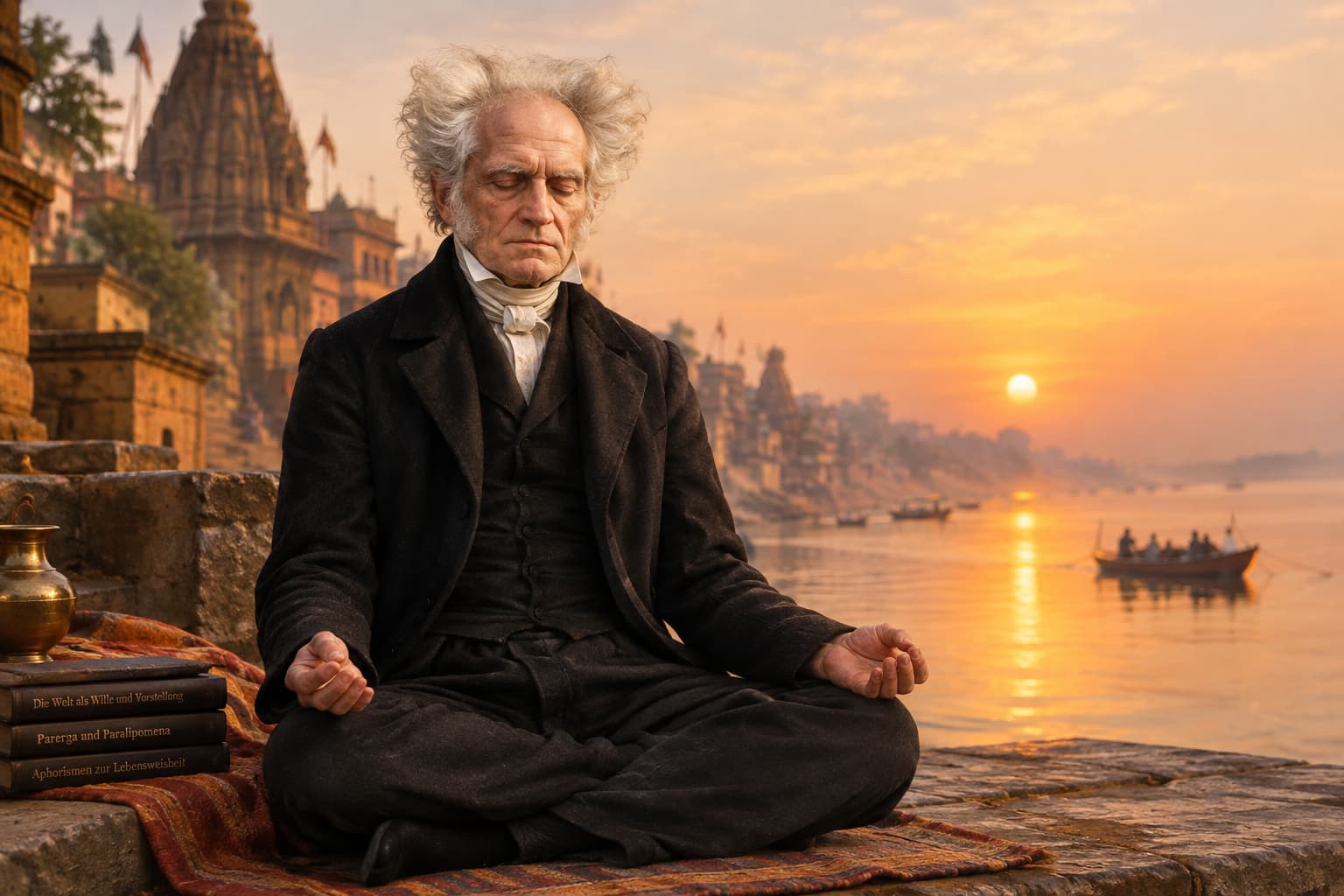
Heraclitus: You cannot step into the same river twice
There is an interesting historical connection here.
Heraclitus of Ephesus, the Greek philosopher who lived around 540–480 BCE, was particularly interested in the nature of change.
He is commonly associated with the observation:
“You cannot step into the same river twice.”
The wording is familiar, although the surviving ancient fragments are more nuanced. The underlying idea is that the river is continually changing, and so is the person stepping into it.
Heraclitus believed that change was fundamental to reality. He was not suggesting that everything happened randomly, however. He also considered the underlying order of the universe, which he referred to as the Logos.
His philosophy is often summarized through the idea that everything is in a state of flux.
And here we have something rather interesting.
Heraclitus was contemplating the nature of change in ancient Greece at roughly the same time that early Buddhist thought was developing in India.
There is no need to suggest that one tradition borrowed from the other. There is no established historical evidence that Heraclitus was influenced by Buddhism, or that the two traditions had any direct intellectual relationship.
Nevertheless, the parallels are striking.
Heraclitus recognised that what appears to be a stable object may actually be a process of continual change.
Buddhism takes this observation further by examining the consequences of our attachment to things that cannot remain permanent.
Heraclitus gives us the river.
Buddhism asks us why we are so determined to own it.
The curious relationship between order and chaos
There is another aspect of the Navier–Stokes problem that deserves a little attention.
Fluid movement can become extraordinarily complex, even when the underlying mathematical rules are relatively straightforward to describe.
A small disturbance can develop into a much more complicated pattern. A seemingly orderly flow can become turbulent. The behavior of the system may become difficult to predict without knowing an enormous amount about its initial conditions.
But this doesn’t mean that the universe has abandoned its rules.
The complexity develops within a system governed by mathematical relationships.
This is an important distinction.
Buddhism does not teach that existence is simply random or that everything happens without cause.
Quite the opposite.
Dependent origination suggests that phenomena arise through an extraordinary network of causes and conditions.
Consider something as ordinary as anger.
We might say that somebody made us angry. But is that really the whole explanation?
Perhaps we were already tired. Perhaps something happened earlier in the day. Perhaps we misunderstood what somebody said. Perhaps an old experience influenced how we interpreted the situation.
The anger may appear to have been caused by one particular event, but the conditions that produced it are considerably more complicated.
We tend to simplify things because our minds prefer convenient explanations.
Reality is frequently less accommodating.
Form is emptiness; emptiness is form
One of the most famous declarations in Mahayana Buddhism appears in the Heart Sutra:
“Form is emptiness; emptiness is form.”
It is a deceptively simple statement that contains an enormous amount of philosophical meaning.
The whirlpool provides a rather good illustration.
We see its form. We can describe it, measure it and observe its movement.
But when we investigate what it actually consists of, we discover that it has no independent existence apart from the conditions that produce it.
Its form is inseparable from the processes that sustain it.
This is not an argument that the whirlpool doesn’t exist.
It is an argument about how it exists.
And perhaps this is one of the most interesting ways to approach the Buddhist understanding of reality.
We spend much of our lives treating things as though they possess permanent identities. We become attached to them, defend them and occasionally become quite unreasonable when somebody threatens our understanding of them.
But perhaps the world is not quite as solid as we think.
Perhaps the things we identify as separate objects are simply temporary expressions of much larger processes.
So what does all this mean?
I wouldn’t suggest that the Navier–Stokes equations prove Buddhism. That would be rather like suggesting that because a physicist can explain how a rainbow forms, the Buddha must have been right about everything.
Mathematics and philosophy are asking different questions.
The mathematical problem concerns the behavior of solutions to equations describing fluid motion. Buddhism is concerned with the nature of existence and the human tendency to become attached to things that are inherently impermanent.
But there is an interesting philosophical connection between them.
The Navier–Stokes equations describe a world of continual movement, interaction and change.
Buddhism encourages us to examine the same characteristics in our own existence.
Heraclitus, meanwhile, was reminding us more than two thousand years ago that the river we think we recognize is never quite the same river.
And perhaps the strangest thing is that we still haven’t entirely learned the lesson.
We spend our lives trying to preserve our youth, our relationships, our possessions and our identities, as though the universe might eventually agree to stop changing if we ask nicely enough.
It won’t.
The river keeps flowing.
The whirlpool eventually disappears.
And the person who stood beside the river yesterday is not quite the person standing there today.
Perhaps the trick is not to stop the water from moving, but to understand why we keep expecting it to stand still. It is, after all, a rather unreasonable demand to make of water, which has been getting along perfectly well without our advice for several billion years.
And if you happen to find yourself contemplating the nature of existence while gazing into a river, do remember that the river is under no obligation to provide answers. It is, however, quite capable of providing a thorough soaking.
As for finding your permanent self, don’t worry if you fail. You may discover that it was never there in the first place. Which is either a profound Buddhist insight or a rather unfortunate case of mistaken identity.
This post contains NO AFFILIATE LINKS and as the author of this post, I earn nothing for recommendations I suggest in my posts on this website. Affiliate linking, when conducted correctly, can be a benefit for the reader and the author, but I choose not to make an additional income from places and products that I personally recommend from my own personal experience. I am not a fan of affiliate linking as, is often the case, an author promotes a business primarily for the financial incentive. Neville David Thomas.
Read more blog posts: https://nevilledavidthomas.com/blog/
Do you agree or disagree with any of the content that I have mentioned in this post? Do you have any additional information that you would like to share? Please leave a comment below!





Leave a Reply